Is There Still a Uu Fellowship at the Arts Castle
History-Edifice
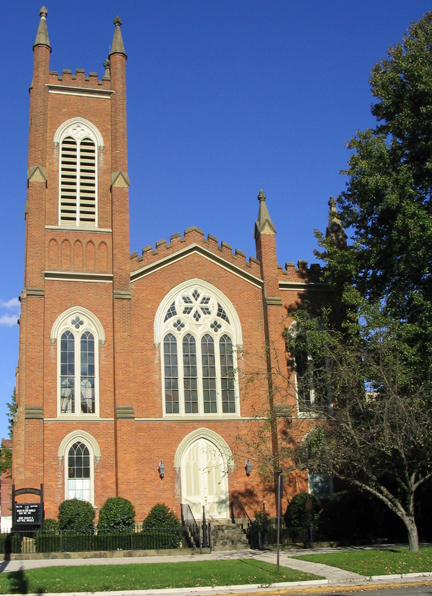 The Unitarian Lodge in Marietta was founded in February 1855 past Nahum Ward (1785-1860), a prominent country speculator and philanthropist. Mr. Ward had arrived in Marietta in 1811. He served this customs as Mayor (1833-36) and was quite the "socialite" of his time. His home, located in the very middle of town, was the site of grand receptions. In 1825, he held a reception for the Marquis de Lafayette and in 1843, John Quincy Adams was his invitee of honor. Existence a Unitarian since his boyhood in New England, Ward decided to identify a notice in the Jan 30, 1855 edition of the Marietta Intelligencer. He asked all friends of liberal Christianity to assemble at the Court Business firm for the purpose of establishing a Unitarian Society in the community.
Structure of their new church began in July of the same year. It was completed ii years later and dedicated on June 4, 1857. The total cost of the building was $25,000 and was assumed by Mr. Ward himself. He so sold information technology to the congregation for the sum of i dollar.
The brick used for the Church was all hand-fabricated from clay taken from the former Indian earthworks at Sacra Via park. The brickwork for the main construction was done by A. Geren, and for the tower by William Kexal. 1 lone white brick can be plant on the Third Street side of the Church building tower. This brick was placed there by a workman considering of a gap left past the original builders. After climbing the 85 ft. tower, the workman placed his "signature" on the structure with this brick (he was paid an additional fifty cents to perform this job).
Stone piece of work in the building's foundation was done by N.S. Alcock and the steps and the stone wall beneath the wrought-iron fence were made by Stepps and Glosser. The fence itself was made at the foundry of Putnam, Poole and Company from across the Muskingum river in Harmar. Although having the appearance of woods, the windowsills are actually made of bandage iron. The window sills forth with the caps and cornices were fabricated at the foundry of Owen Franks in Marietta. Franks, a long-time member of both the Unitarian and Universalist societies here, was also a noted riverboat helm and one of the owners of "Larchmont" a grand home still privately occupied on 2d Street.
The overall design of the Church building is Gothic and is an imitation of a rural chapel which Ward had admired during 1 of his visits to England. The architect was Mr. John M. Slocomb, who also designed other Marietta landmarks including the "Castle" on 4th Street and St. Luke's Episcopal Church on Second Street. Structure of our Church was supervised by Nahum Ward's son, William S. Ward.
The woodwork on the interior is spectacular and was painted to wait like oak past Northward.H. Shaw while the glazing work was washed by John Clintworth. The curving stairway that leads to the balcony has a banister of heavy walnut and was the work of a onetime slave who gained his freedom in the south through his skills as a craftsman.
The painting on the wall behind the pulpit is entitled "Christ Weeping Over Jerusalem". Information technology was originally done in plaster during or soon after the structure of the Church. Information technology was painted by noted Marietta artist, Sala Bosworth and is an imitation of a painting of the aforementioned proper noun by the English artist, Sir Charles Eastlake. The Eastlake original (merely three feet in length) is in the Tate Gallery in London. The positioning of the figures is somewhat dissimilar in the Bosworth painting, and it has been said that the effigy of Simon Peter somewhat resembles Nahum Ward, himself.
At that place is scripture and doxology (St. John and Exodus) painted on a screen to the right of the pulpit area. The artist is unknown. Behind this screen is a stairway that once led from the pastor'due south study (now children's plant nursery) directly to the pulpit.
The original stained-glass windows of the Church were replaced some time in the early on 1900's past the nowadays windows which are dedicated to the memories of former members. Merely i window retains the original nineteenth century design.
All of the interior woodwork, wainscoting, and pews are the original. Some of the pews yet behave the nameplates that identify the families that used them in the 1800's. In the early days of the Church, contributions took the course of pew rentals, paid semiannually. Pews so identified include those of Nahum Ward, Captain Owen, and other church building founders.>
Like many of the older buildings in downtown Marietta, the UU Church suffered heavily during the years when the Muskingum and Ohio rivers regularly overflowed their banks. Thankfully the locks and dams organisation of the rivers now prevents major flooding. The damage was particularly bad during the disastrous floods of 1884, 1907, 1913, and 1937. In 1913, for example, floodwaters rose to completely comprehend the basement and to a peak of three feet in the sanctuary. During the 1884 flood, the Church's original pipe organ was destroyed and a new organ was purchased and placed upstairs in the Church building balcony in 1907. Unfortunately, this organ required major repair that was prohibitively expensive. Thus, information technology was dismantled in 2007 and the rear window was revealed. This brightened the sanctuary immensely. The pipes of the original organ still grace the left side of the sanctuary.
The original bell however hangs in the bell tower of the Church. This bell was brought to Marietta on November 5, 1856 aboard the riverboat steamer "Lightfoot". The bell was made in the historic foundry of J. McNeeley and Sons in Troy, New York. It weighs 1100 pounds and its distinctive tone is the result of the unusually large quantity of silvery used in the alloy. Unfortunately, the bell was cracked in early 1939 and is now only heard when an occasional mischievous youth cannot resist the temptation.
The original parsonage (now the Church office, religious educational activity building, and private rental) is located next to the Church. This edifice was built in 1871 on land purchased by William S. Ward (Naham'south son). The edifice was used equally a home for the ministers of the Church building until the late 1960'southward when a long-fourth dimension member bequeathed her lovely home to the church building for employ as the minister's habitation.
Source: https://fuusm.org/index.php?page=history
0 Response to "Is There Still a Uu Fellowship at the Arts Castle"
Post a Comment